


NEWS & INSIGHTS
The latest industry insights & news from CCSI, Specialists in Establishing Contact Centers in Mexico for Debt Collection, Customer Service, Sales, BPO and more.

NEWS & INSIGHTS
The latest industry insights & news from CCSI, Specialists in Establishing Contact Centers in Mexico for Debt Collection, Customer Service, Sales, BPO and more.
Noise can be a common challenge in a busy call center. Agents speaking with customers, supervisors communicating with teams, meetings, office equipment, and other activity can all contribute to background noise on the operations floor.
Excessive background noise can make it harder for agents to listen, concentrate, and communicate clearly. It may also be transmitted through calls, distracting customers and creating an unprofessional impression.
A quieter environment can help agents focus on conversations, hear customers more clearly, and provide a better overall customer experience. This is particularly important for organizations managing high-volume customer service contact center operations.
Reducing unnecessary background noise helps create a work environment where agents can focus on the customer instead of competing with the sounds around them.
Workplace noise should also be considered from an occupational health and safety perspective. Applicable requirements depend on the country, facility, and level and duration of employee exposure.
For U.S. general industry workplaces, OSHA requires a hearing conservation program when employee noise exposure equals or exceeds an 8-hour time-weighted average of 85 dBA. OSHA's permissible exposure limit is 90 dBA over an 8-hour time-weighted average. More information is available through the OSHA Occupational Noise Exposure resource.
In Mexico, workplace noise is addressed through NOM-011-STPS-2001, which establishes safety and hygiene requirements for workplaces where noise is generated. Organizations should evaluate the regulations applicable to their specific facilities and operations.
The following suggestions can help reduce unnecessary noise and improve the working environment for contact center agents.
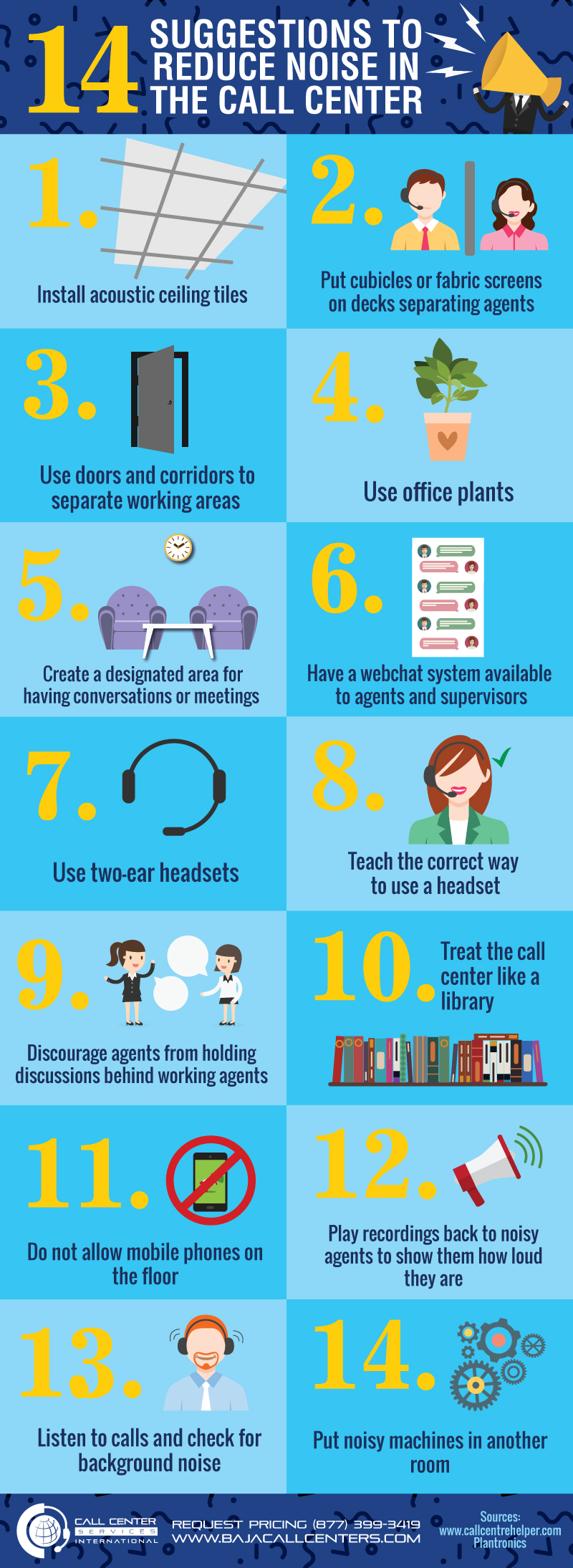
Acoustic ceiling tiles and other sound-absorbing materials can help reduce reverberation and echo throughout the contact center.
Acoustic treatment should be considered together with workstation layout, meeting areas, equipment placement, and the overall design of the contact center facility.
Partitions between workstations can help reduce the amount of nearby conversation reaching each agent. When agents can hear their calls more clearly, they may also be less likely to raise their own voices.
Large open areas can allow sound to travel throughout the operations floor. Separating activities into appropriate areas can help contain noise and create quieter spaces for work that requires greater concentration.
Modern contact center facilities in Mexico can incorporate dedicated training rooms, conference rooms, break areas, client workspaces, and operations floors so that different activities do not unnecessarily interfere with live customer interactions.
Plants can help divide open spaces and create visual separation between work areas. They should complement, rather than replace, appropriate acoustic materials when significant noise reduction is required.
Encourage employees to use designated meeting, collaboration, and break areas instead of holding extended conversations near agents who are actively handling calls.
Keeping unnecessary conversations away from the operations floor can improve concentration and reduce the amount of background speech transmitted to customers.
Internal chat and messaging systems can be used for announcements and routine communication so supervisors do not need to raise their voices across the operations floor.
Technology should support communication without adding unnecessary disruption. CCSI's broader IT Support capabilities include multichannel tools and technology infrastructure designed to support professional contact center operations.
Two-ear headsets can help agents focus on the customer conversation while reducing distractions from nearby voices and workplace activity.
Headset selection should be based on the work environment, equipment compatibility, comfort, call requirements, and manufacturer recommendations.
Agents should understand the proper position of the microphone and earphones. Incorrect microphone placement may cause employees to speak louder than necessary or reduce call clarity.
Proper headset use should be part of a broader agent training strategy that includes communication skills, active listening, phone etiquette, and customer interaction techniques. Learn more about CCSI's bilingual call center agents and training programs.
Employees should avoid holding discussions immediately behind agents who are handling customer interactions.
Background conversations can distract the agent and may also be audible to the customer.
The original recommendation was to “treat the call center like a library.” While complete silence is unrealistic in an active contact center, employees, visitors, and supervisors can still be encouraged to keep conversations at an appropriate volume around working agents.
A professional operations environment is one of several factors that can contribute to the broader benefits of a well-managed nearshore contact center, along with workforce quality, infrastructure, proximity, and operational control.
Personal calls and conversations should take place in designated areas rather than beside employees handling customer interactions.
Contact centers may also maintain separate mobile-device policies for security, confidentiality, or compliance purposes depending on the client program.
Employees may not realize how much background noise is being transmitted until they hear a recording from the customer's perspective.
Playing appropriate examples during coaching sessions can help agents understand how voice volume and surrounding conversations affect call quality.
Call recordings can also support Quality Assurance and Call Monitoring by helping supervisors identify recurring issues and provide targeted coaching.
Quality assurance monitoring should consider not only what the agent says but also the overall quality of the customer interaction.
Listening for background conversations, equipment noise, poor microphone placement, or other distractions can help identify recurring problems on the operations floor.
A structured QA program can combine call monitoring, scorecards, coaching, and performance analysis to improve consistency across customer interactions.
Printers, mechanical equipment, maintenance systems, and other noise-producing devices should be placed away from agents whenever practical.
Separating the source of unnecessary noise from employees is often one of the simplest ways to improve the acoustic environment.
Noise reduction should not be treated as a one-time project. Contact centers can periodically review the operations floor, listen to recorded interactions, ask agents for feedback, and identify new sources of unnecessary noise.
Facility layout, acoustic materials, headset selection, agent behavior, supervisor communication, technology, and quality monitoring can all contribute to a quieter and more professional working environment.
Organizations establishing a new operation can also consider these factors during implementation rather than attempting to correct them later. CCSI's Turnkey Nearshore Contact Center Program provides existing facilities, IT infrastructure, administrative support, training, Quality Assurance, and operational resources for companies establishing teams in Mexico.
A better acoustic environment can benefit both sides of the conversation: agents can concentrate more effectively, while customers receive clearer and more professional interactions.
A well-designed working environment also supports the people using it. CCSI's bilingual and bicultural call center workforce is supported by professional facilities, training, supervision, and quality assurance processes designed to help agents deliver consistent customer interactions.
Call Center Services International (CCSI) helps U.S. companies establish and manage high-performance bilingual nearshore contact centers in Mexico.
CCSI provides professional facilities, bilingual talent, technology infrastructure, quality assurance, administrative support, and operational resources that allow clients to expand their contact center capacity while maintaining control over their processes and performance standards.
Our nearshore call center services support customer service, debt collection, financial services, sales, technical support, quality assurance, and other business processes from strategic locations in Mexico.
Explore CCSI's Nearshore Contact Center Facilities
Historical note: This article and infographic were originally published in 2017. The original 14 recommendations have been preserved while terminology, workplace communication practices, internal links, and occupational noise references have been reviewed for current relevance.
Originally published: March 4, 2017
Last reviewed and updated: July 25, 2026



The latest industry insights & news from CCSI, Specialists in Establishing Contact Centers in Mexico for Debt Collection, Customer Service, Sales, BPO and more.

![14 Suggestions to Reduce Noise In The Call Center [INFOGRAPHIC]](https://ccsi.com/images/2020/03/16/Reduce-Noise-Call-Center800_large.jpg)