

NEWS & INSIGHTS
The latest industry insights & news from CCSI, Specialists in Establishing Contact Centers in Mexico for Debt Collection, Customer Service, Sales, BPO and more.

NEWS & INSIGHTS
The latest industry insights & news from CCSI, Specialists in Establishing Contact Centers in Mexico for Debt Collection, Customer Service, Sales, BPO and more.
Customer Experience has become one of the most important competitive factors in contact center operations. Customers expect faster responses, connected interactions, knowledgeable agents, easy resolutions, and increasingly personalized service. But how important is Customer Experience in measurable terms? Recent research provides some powerful numbers that every contact center leader should understand.
When this article was originally published in 2018, CCSI collected nine statistics illustrating the growing importance of Customer Experience. The specific numbers have changed over time, but the original message has become even more relevant: the quality of the customer interaction directly affects loyalty, retention, operational performance, and revenue.
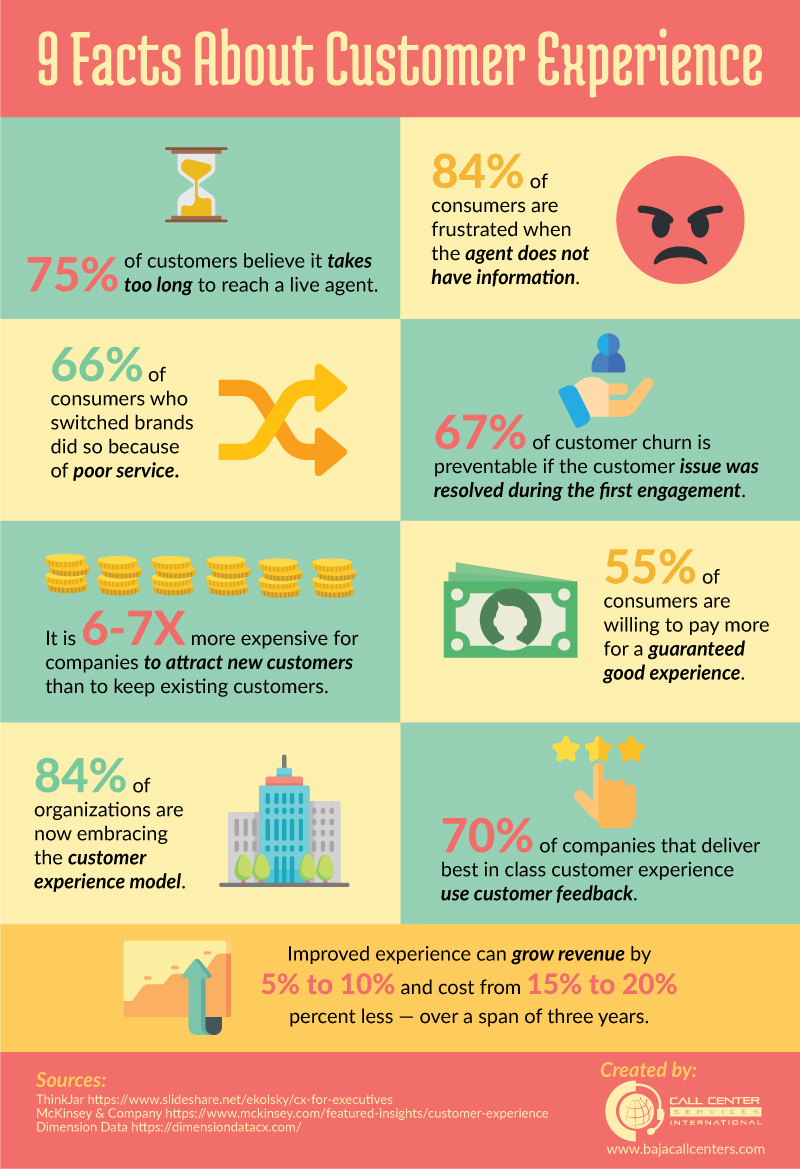
The infographic below is preserved from the original 2018 article as a historical snapshot of Customer Experience research available at that time.
80% of customers say the experience a company provides is as important as its products and services.
Customer Experience is no longer something that happens only after a purchase when someone calls Customer Service. Customers evaluate the complete relationship they have with an organization — from marketing and sales to onboarding, service, billing, support, and problem resolution.
For contact centers, this means agents are not simply answering calls or messages. They are directly influencing how customers perceive the company.
This is one reason CCSI's nearshore Customer Service solutions focus on integrating teams with each client's processes, systems, training, brand standards, and Customer Experience objectives.
Source: Salesforce, State of the Connected Customer research.
88% of customers say good customer service makes them more likely to purchase again.
Customer service is therefore not only a support function. It can contribute directly to customer retention and lifetime value.
An effective interaction can reinforce the customer's decision to continue doing business with the company, while repeated poor experiences can create the opposite effect.
Organizations should consider Customer Service performance alongside broader business metrics rather than viewing the contact center exclusively as a cost center.
Strong agent training and development, product knowledge, Quality Assurance, communication skills, and employee engagement can all contribute to more consistent customer interactions.
Source: Salesforce Customer Experience research.
77% of customers expect to interact with someone immediately when they contact a company.
Waiting has always been a source of customer frustration, but expectations for accessibility continue to increase as customers become accustomed to real-time digital experiences.
Contact centers need to balance staffing, Workforce Management, self-service, automation, and live-agent availability so customers can receive help without unnecessary delays.
Increasing agent capacity through a nearshore contact center model can also provide organizations with additional workforce flexibility while maintaining alignment with North American business hours.
Source: Salesforce Customer Experience research.
74% of consumers say it is frustrating to have to tell their story repeatedly to different agents.
This is one of the clearest examples of how disconnected systems and departments can damage Customer Experience.
A customer does not care whether one interaction belongs to Sales, Billing, Technical Support, or Customer Service. From the customer's perspective, all of those departments represent the same company.
CRM integration, accurate case notes, interaction histories, accessible knowledge bases, and communication between departments can help prevent customers from having to start over every time they speak with someone new.
Improving First Contact Resolution can reduce this type of customer effort by helping agents solve more issues without unnecessary transfers, escalations, or repeat contacts.
Source: Zendesk CX Trends 2026.
88% of customers expect faster response times than they did just one year ago.
Customer expectations are not static. A response time that seemed acceptable several years ago may now feel slow because customers compare service experiences across industries.
Customers accustomed to real-time banking, instant messaging, same-day delivery, and automated digital services increasingly expect Customer Service to operate with similar speed.
This does not mean contact centers should focus exclusively on Average Handle Time or speed. A fast interaction that fails to resolve the customer's problem can create another contact and ultimately increase both customer effort and operational cost.
CCSI's Quality Assurance and Call Monitoring services help organizations evaluate the quality and effectiveness of customer interactions in addition to traditional productivity metrics.
Source: Zendesk CX Trends 2026.
76% of customers say they would choose a company that allows them to share text, images, and video within the same conversation without having to start the process over.
Customer Experience is no longer limited to the telephone.
Customers may begin an interaction through web chat, continue by text, send a photograph or document, receive an email, and eventually speak with a live representative.
The challenge is maintaining the context of that interaction as customers move across channels.
Modern contact center strategies increasingly combine live agents with AI-powered voice and virtual agents that can support interactions across voice, SMS, email, and web chat.
Source: Zendesk CX Trends 2026.
Approximately 11% of customer experiences globally are reported as bad experiences.
No organization can realistically expect every interaction to be perfect.
The important question is whether companies can identify what went wrong, recover the customer relationship, and prevent the same issue from happening repeatedly.
Customer complaints, Quality Assurance evaluations, interaction analytics, escalation patterns, customer surveys, repeat contacts, and frontline employee feedback can all help reveal where the experience is breaking down.
Contact center leaders should therefore treat negative interactions as a source of operational information, not simply isolated complaints.
Source: Qualtrics XM Institute 2026 Consumer Experience research.
47% of bad customer experiences lead consumers to reduce or stop spending with the organization.
Qualtrics XM Institute estimates that poor Customer Experience puts nearly $3 trillion in global sales at risk in 2026.
For U.S. organizations alone, the analysis estimates approximately $973 billion in sales at risk from poor experiences.
These figures reinforce something contact center leaders have understood for years: Customer Experience is directly connected to business performance.
Agent training, sufficient staffing, effective processes, accessible information, Quality Assurance, First Contact Resolution, and appropriate escalation procedures are therefore not simply operational concerns. They can affect whether customers continue spending with the company.
Organizations experiencing service failures should also have a defined recovery process. CCSI's article on managing bad Customer Service experiences outlines practical steps including listening, responding quickly, appropriate service recovery, escalation, and follow-up.
Source: Qualtrics XM Institute, 2026 Consumer Experience research.
80% of customers say it is important for a human to validate the output of AI.
Artificial Intelligence is rapidly becoming part of Customer Service, but automation does not eliminate the importance of trust.
AI can help answer routine questions, analyze large numbers of interactions, provide information to agents, automate repetitive tasks, and make Customer Service available at greater scale.
At the same time, organizations need to determine when human judgment, review, empathy, or intervention remains appropriate.
CCSI's current AI Contact Center Solutions combine automation with customer service operations, including Generative AI Voice and Virtual Agents and AI-powered Quality Assurance and Compliance monitoring.
AI-powered QA can also help supervisors identify coaching opportunities and interaction trends across a much larger percentage of customer conversations than traditional manual sampling.
Source: Salesforce State of the Connected Customer research.
The numbers have changed since CCSI first published this infographic in 2018, but the fundamental lessons remain remarkably consistent.
Customers want:
Providing that experience requires more than one department or one technology platform.
It involves recruiting, training, employee engagement, Workforce Management, Quality Assurance, technology, processes, customer feedback, leadership, and continuous improvement.
This is also why Employee Experience matters. Experienced, motivated, well-trained employees are better positioned to understand the business and provide consistent interactions to customers.
Traditional contact center metrics such as Average Handle Time, abandonment rate, occupancy, and service level remain useful, but they do not tell the complete Customer Experience story.
Organizations should also consider measurements such as:
CCSI's Quality Assurance specialists help organizations monitor customer interactions, evaluate performance, identify coaching opportunities, and produce business intelligence that can support better operational decisions.
For organizations looking to expand the amount of interaction data they can evaluate, CCSI's AI-powered QA & Compliance Agents can monitor and analyze customer interactions at scale while identifying quality, compliance, and training opportunities.
The strongest lesson from both the original 2018 statistics and today's research is that Customer Experience should not be treated as a secondary contact center initiative.
Customers connect service quality with the company itself. Their experience influences whether they purchase again, recommend the business, increase or decrease spending, or move to a competitor.
For contact center leaders, the opportunity is to connect Customer Experience goals with measurable operational improvements: better training, stronger agent knowledge, improved First Contact Resolution, easier access to information, effective Workforce Management, Quality Assurance, customer feedback, and appropriate technology.
CCSI helps U.S. organizations expand their Customer Service operations through experienced bilingual and bicultural agents in Mexico while allowing clients to maintain their own processes, systems, training, KPIs, and Customer Experience standards.
Call Center Services International (CCSI) helps U.S. companies establish and manage high-performance nearshore contact center operations in Mexico.
CCSI combines experienced bilingual and bicultural professionals with continuous training, recruiting, Human Resources, Workforce Management, professional facilities, technology infrastructure, Quality Assurance and Call Monitoring, and local operational support.
Clients can integrate their own customer service processes, systems, training, performance goals, Quality Assurance standards, and Customer Experience requirements into their Mexico teams.
CCSI also provides AI-powered solutions that complement live-agent operations through virtual agents, intelligent automation, and advanced Quality Assurance and interaction analysis.
Strengthen Your Customer Experience With CCSI
Historical note: This article was originally published in May 2018 with an infographic containing nine Customer Experience statistics available at that time. The original infographic has been preserved as part of CCSI's historical content, but its statistics should not be interpreted as current data. The article has been updated with recent Customer Experience research and current discussion of First Contact Resolution, omnichannel service, Quality Assurance, Employee Experience, AI, and customer retention.
Originally published: May 9, 2018
Last reviewed and updated: July 26, 2026



The latest industry insights & news from CCSI, Specialists in Establishing Contact Centers in Mexico for Debt Collection, Customer Service, Sales, BPO and more.

![9 Customer Experience Facts Your Contact Center Can’t Afford To Ignore [INFOGRAPHIC]](https://ccsi.com/images/2020/03/16/Facts-Customer-Experience_large.jpg)