

NEWS & INSIGHTS
The latest industry insights & news from CCSI, Specialists in Establishing Contact Centers in Mexico for Debt Collection, Customer Service, Sales, BPO and more.

NEWS & INSIGHTS
The latest industry insights & news from CCSI, Specialists in Establishing Contact Centers in Mexico for Debt Collection, Customer Service, Sales, BPO and more.
For Call Center executives, what does efficiency imply? It might include reducing the number of customer escalations or improving key performance indicators such as Average Handle Time (AHT) or First Call Resolution (FCR). Effective Workforce Management can help organizations align staffing, performance, customer demand, and operational resources to support these goals.
Running a successful Call Center requires a combination of employee training, consistent management, the right technology, and effective operational planning. One factor that plays a particularly important role is Call Center Workforce Management (WFM).
Your Call Center workforce is one of your most valuable assets, and effective Workforce Management can significantly improve operational efficiency.
Workforce Management helps organizations align staffing levels, employee skills, scheduling, and customer demand. When these elements work together, Contact Centers can provide better customer experiences while using their resources more efficiently.
To better understand the fundamentals, review CCSI's article on Call Center Workforce Management, which covers forecasting, scheduling, staffing, and the role WFM plays in supporting agents and customers.
As a Call Center manager or leader, there are many KPIs to meet, but profitability and long-term success depend heavily on providing a consistent customer experience.
Workforce Management provides the structure that helps agents deliver this level of service. By helping ensure that the right people with the right skills are available at the right time, WFM can support both operational efficiency and better Customer Service.
Here are three of the most significant advantages of Workforce Management:
Every time a customer interacts with your company, they have expectations about the quality and speed of the service they receive. A poor experience can have a significant impact even when previous interactions were positive.
WFM helps managers ensure that agents with the necessary training, skill sets, and knowledge are available to assist with customer needs as they enter the queue. This contributes to more consistent support experiences and can strengthen customer satisfaction and loyalty over time.
Workforce planning can also complement a structured Quality Assurance and Call Monitoring program, helping management evaluate how staffing, performance, and service quality interact.
Agent satisfaction can also be supported through effective Workforce Management. A well-supported Call Center agent is better positioned to provide a positive and productive experience for customers.
But what happens when a Call Center is consistently understaffed and each agent is expected to handle a higher workload? This can place significant pressure on employees, increasing the risk of burnout and attrition.
Effective WFM practices can make agent engagement and satisfaction easier to achieve by helping create more balanced schedules and workloads.
Employee engagement also connects directly with broader factors such as recognition, development, communication, and the overall company culture.
Effective Workforce Management requires understanding how many agents are needed at any given time. Without accurate forecasting, organizations may be tempted to overstaff their teams to avoid being overwhelmed by customer demand. However, overstaffing can result in excessive idle time and unnecessary labor costs.
On the other hand, understaffing can also become expensive in the long run. It can negatively affect the customer experience by increasing wait times while placing additional pressure on agents, potentially contributing to higher turnover and lower customer satisfaction.
Effective Workforce Management can also help organizations identify and reduce issues such as:
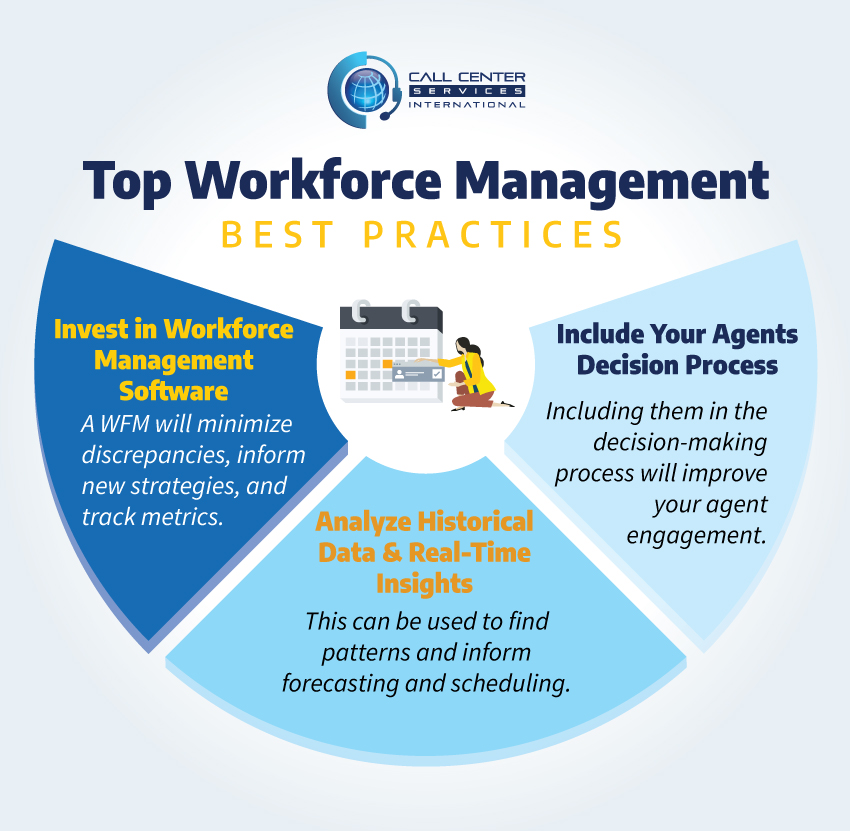
To keep your Contact Center operations running smoothly, consider adopting the following Workforce Management best practices:
Spreadsheets and manual schedules may not be sufficient for managing the complexity of larger or more distributed Contact Center operations.
With organizations managing on-site, remote, and hybrid teams, having the right technology to support WFM efforts can become increasingly important. A Workforce Management solution can help organizations:
These capabilities can be particularly valuable for organizations operating remote or Work-From-Home Contact Center teams, where visibility into staffing, availability, and performance remains an important part of the operating model.
Workforce managers need access to reliable data and analytics. What cannot be measured is difficult to improve, and WFM strategies should therefore be supported by both historical information and current operational data.
Track periods of higher employee absenteeism and previous peaks in customer contact volume to prepare for potential staffing challenges. Historical data can also reveal patterns that help improve forecasting and scheduling decisions.
Combining historical trends with real-time insights allows managers to adjust staffing decisions when actual demand differs from forecasts, helping the Contact Center respond more effectively to changing conditions.
Your agents are not simply numbers on a schedule. Employees may value greater visibility and flexibility regarding working hours, vacation requests, or schedule preferences.
While analytics and business requirements may suggest scheduling the same experienced agents during every peak period, repeatedly relying on those employees can eventually create unnecessary pressure and contribute to burnout.
Including agents in the Workforce Management process can support agent engagement. Providing appropriate channels for employees to communicate scheduling needs and time-off requests also gives managers more information to plan staffing requirements in advance.
At CCSI, we take pride in our agents' interpersonal skills, motivated attitude, technology knowledge, and service-oriented mindset. Our Mexico Call Center agents are selected and developed for their ability to communicate effectively, accomplish tasks, achieve goals, and maintain a strong work ethic.
CCSI focuses not only on providing agents with the knowledge and Call Center skills required for their roles, but also on developing communication, active listening, technology, customer service, and negotiation skills that support successful customer interactions.
Through effective Workforce Management, continuous training, employee development, and a people-focused culture, organizations can create an environment where agents are better prepared to serve customers while Contact Center leaders maintain the staffing levels and operational efficiency necessary to meet business objectives.
Call Center Services International (CCSI) helps U.S. organizations establish and manage Nearshore Contact Center operations in Mexico. CCSI combines professional bilingual and bicultural agents with recruiting, training, Workforce Management, Quality Assurance, technology infrastructure, and operational support.
CCSI supports Customer Service and other BPO operations through professional Contact Center environments and flexible Work-From-Home models, helping organizations expand workforce capacity while maintaining close alignment with U.S. operations.
CCSI's people-first company culture emphasizes employee development, recognition, engagement, and internal growth, supporting experienced teams that can provide consistent service for client operations.
Historical note: First published in April 2022, this article has been reviewed and updated while preserving its original focus on Workforce Management efficiency, staffing, forecasting, agent engagement, scheduling technology, and employee participation. Language and examples have been refined for clarity while maintaining the original Workforce Management principles and recommendations.
Originally published: April 11, 2022
Last reviewed and updated: July 26, 2026



The latest industry insights & news from CCSI, Specialists in Establishing Contact Centers in Mexico for Debt Collection, Customer Service, Sales, BPO and more.