

NEWS & INSIGHTS
The latest industry insights & news from CCSI, Specialists in Establishing Contact Centers in Mexico for Debt Collection, Customer Service, Sales, BPO and more.

NEWS & INSIGHTS
The latest industry insights & news from CCSI, Specialists in Establishing Contact Centers in Mexico for Debt Collection, Customer Service, Sales, BPO and more.
Strong leadership is essential in contact center operations. Supervisors and managers need to guide people toward common goals while supporting performance, customer experience, professional development, and employee engagement. Leadership may come more naturally to some people than others, but many of the skills that make someone a better leader can be learned, practiced, and continuously improved.
Leadership training for contact center supervisors and managers is important because agents need more than someone who monitors metrics. They need leaders who can coach them, communicate expectations, help solve problems, encourage professional development, and motivate the team to deliver strong customer service.
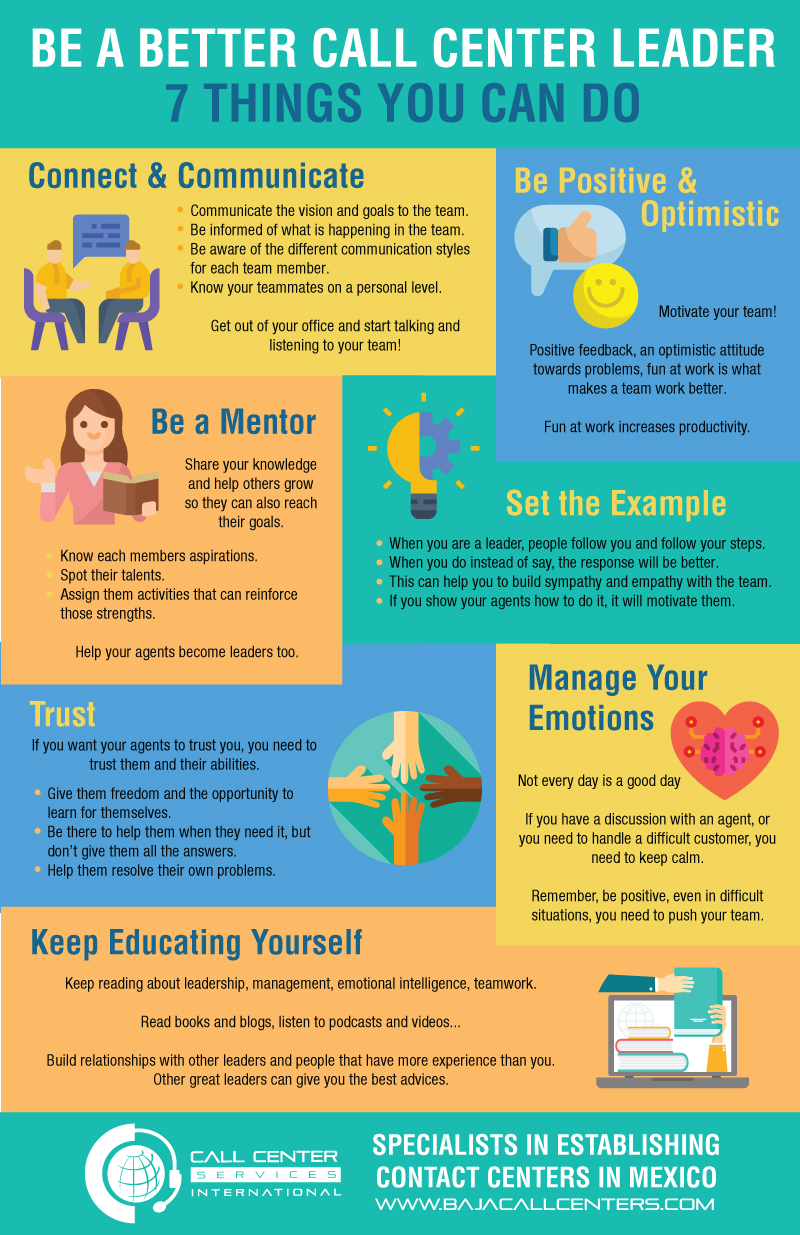
The seven recommendations from the original 2017 article remain highly relevant for today's contact center leaders.
One of the responsibilities of a leader is to communicate the company's vision, objectives, expectations, and priorities to the team. But effective communication does not end with giving instructions.
An important part of communication is listening.
Leaders need to understand what is happening within their teams, what challenges agents are experiencing, and where employees may need additional support.
Different people also communicate differently. Some employees may respond better to direct feedback, while others may benefit from more discussion, examples, or coaching. Strong leaders learn how to communicate effectively with the individuals on their teams.
Managers should not communicate only when a metric is missed or a problem occurs.
Regular conversations give supervisors opportunities to understand employees' professional goals, concerns, strengths, ideas, and development needs.
This type of open communication also supports the broader employee experience and company culture by helping employees feel heard and connected to leadership.
Contact center work can sometimes be demanding. Agents may handle difficult customers, changing workloads, performance goals, complex processes, or high interaction volumes throughout the day.
A leader's attitude can influence how the team responds to those pressures.
Positive leadership does not mean ignoring problems or pretending that every situation is easy. It means approaching problems constructively and helping employees focus on what can be done next.
Leaders naturally spend significant time correcting problems, but they should also recognize good performance.
Positive feedback helps employees understand which behaviors should be repeated and reinforces accomplishments that might otherwise go unnoticed.
Recognition can be as simple as congratulating someone after a difficult interaction, acknowledging improvement during a coaching session, or sharing an accomplishment with the rest of the team.
CCSI's current culture strategy places recognition, motivation, and employee development among the foundations of building stable, high-performing teams.
One of the most valuable parts of leadership is the opportunity to share knowledge and help other people grow.
Supervisors and managers should understand the strengths, development needs, and professional goals of the people they lead.
When leaders identify potential, they can create opportunities for employees to build new skills, take on additional responsibilities, participate in projects, or prepare for future roles.
Leadership should not be focused only on the manager's own success. Strong leaders develop people who may eventually become team leads, supervisors, managers, trainers, Quality Assurance specialists, Workforce Management professionals, or leaders themselves.
This principle is now formally reflected in CCSI's Leadership Program, which provides high-potential employees with skills development, mentorship, and experience designed to prepare them for management opportunities.
Developing leaders internally also creates managers who already understand the operation, employees, clients, processes, and organizational culture.
Employees pay attention to what their leaders do, not only to what they say.
If you expect agents to communicate respectfully with customers, communicate respectfully with your employees. If you expect accountability, demonstrate accountability. If you expect professionalism, consistency, preparation, and teamwork, model those behaviors yourself.
Showing employees how a standard should be applied can often be more effective than simply telling them what they should do.
Supervisors influence the tone of the team through everyday actions.
How a leader handles mistakes, communicates during stressful situations, responds to customer problems, gives feedback, and treats employees can gradually establish what the team considers normal behavior.
For this reason, leadership plays an important role in maintaining consistent customer service standards throughout a contact center operation.
Trust works in both directions.
Leaders want employees to trust their decisions, feedback, and support. In return, managers also need to demonstrate appropriate trust in the employees they have trained to do the job.
New supervisors sometimes feel they need to monitor every action because they are responsible for the team's performance. Excessive control, however, can prevent employees from developing judgment and confidence.
Good leadership requires finding the appropriate balance between oversight and autonomy.
When an agent asks for help, the fastest response may be to simply provide the answer. But sometimes a better coaching approach is to help the employee work through the problem.
Ask questions. Help agents evaluate options. Encourage them to use available resources and explain how they reached their decision.
Over time, this can build confidence and create employees who are better equipped to make appropriate decisions independently.
Agent empowerment also depends on having appropriate training, clearly defined authority, accessible information, and Quality Assurance processes that help employees understand expectations.
Contact centers can include stressful moments for both agents and managers.
A difficult customer interaction, missed performance target, technical problem, staffing issue, client escalation, or disagreement between team members can create pressure.
Leaders are human and experience frustration like everyone else, but leadership requires learning how to respond constructively when emotions are high.
Employees often look to their supervisor when something goes wrong.
Remaining calm does not mean ignoring the seriousness of a situation. It means gathering information, communicating clearly, avoiding impulsive reactions, and helping the team focus on an appropriate solution.
Emotional awareness can also improve coaching. Difficult feedback is more useful when it is delivered professionally and with the objective of helping the employee improve.
Quality data can support these conversations by giving leaders objective information to discuss. CCSI's Quality Assurance and Call Monitoring processes help identify performance trends and coaching opportunities rather than relying only on subjective impressions.
Leadership development does not stop when someone becomes a supervisor or manager.
Contact centers continue to evolve through new customer expectations, technologies, communication channels, AI, workforce models, regulatory requirements, and management practices. Leaders need to evolve with them.
Continue learning about:
Books, professional courses, industry events, articles, webinars, podcasts, and training programs can all provide useful information.
One of the most valuable learning resources, however, can be other experienced leaders. Building relationships with people who have managed similar challenges provides opportunities to learn from situations they have already experienced.
The seven principles from the original article are interconnected.
Communication builds trust. Trust creates opportunities for empowerment. Mentorship develops employees. Emotional awareness improves coaching. Setting the right example reinforces culture. Continuous learning makes the leader more capable of supporting all of these areas.
Good contact center leadership is ultimately about creating an environment where employees understand what is expected of them, have the tools and knowledge to succeed, receive useful feedback, and see opportunities to grow.
A successful contact center leader is not measured only by personal performance, but also by the people they help develop.
That philosophy is especially important in organizations that promote from within. CCSI's current employee-development model emphasizes continuous learning and internal career paths designed to turn experienced employees into future leaders.
Call Center Services International (CCSI) helps U.S. companies establish and manage high-performance bilingual nearshore contact centers in Mexico.
CCSI invests in employee development through continuous training, professional learning, mentorship, internal career opportunities, and a structured Leadership Program designed to prepare high-potential employees for management roles.
This approach helps CCSI develop experienced leaders who understand the organization from the operational level upward while supporting stable teams of bilingual and bicultural contact center professionals.
By combining leadership development with Quality Assurance, Workforce Management, professional facilities, technology infrastructure, recruiting, Human Resources, and a people-first culture, CCSI helps clients build teams focused on long-term performance and customer experience.
Discover CCSI's Leadership & Employee Development Culture
Historical note: This article was originally published in 2017. Its seven original leadership recommendations — communicate, remain positive, mentor others, set an example, build trust, manage emotions, and continue learning — have been preserved while the language, structure, internal links, and discussion of coaching, empowerment, employee experience, and CCSI's current leadership-development programs have been updated for current relevance.
Originally published: November 29, 2017
Last reviewed and updated: July 26, 2026



The latest industry insights & news from CCSI, Specialists in Establishing Contact Centers in Mexico for Debt Collection, Customer Service, Sales, BPO and more.