
NEWS & INSIGHTS
The latest industry insights & news from CCSI, Specialists in Establishing Contact Centers in Mexico for Debt Collection, Customer Service, Sales, BPO and more.

NEWS & INSIGHTS
The latest industry insights & news from CCSI, Specialists in Establishing Contact Centers in Mexico for Debt Collection, Customer Service, Sales, BPO and more.
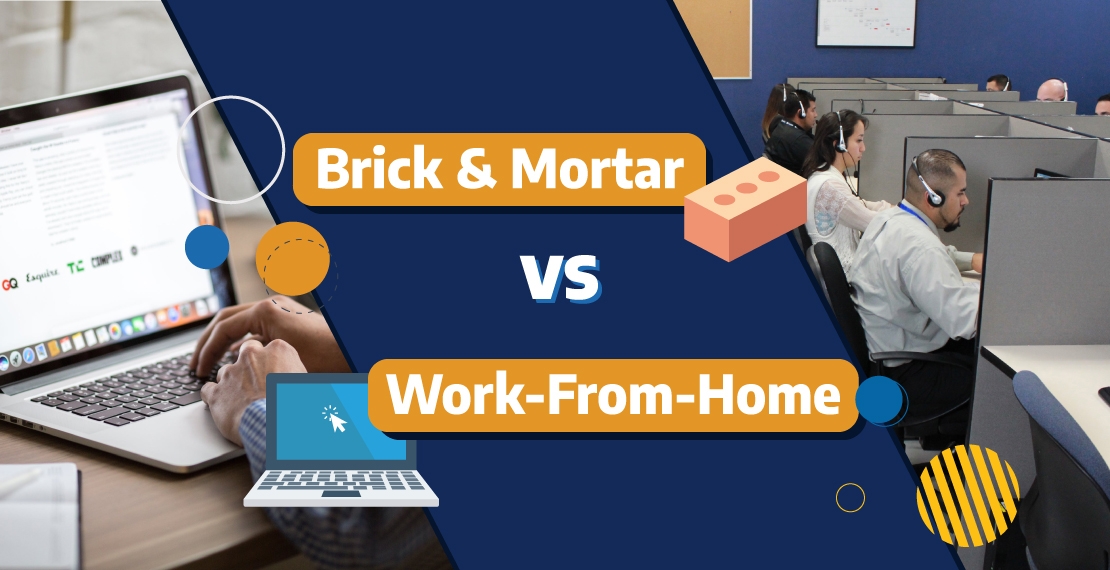
The Work-From-Home era arrived earlier than many organizations expected. While remote agents were already part of the contact center industry before 2020, the rapid expansion of remote work changed how companies think about workforce location, technology, security, employee experience, and business continuity. Today, the decision is not simply Brick-and-Mortar versus Work-From-Home, but determining which operating model — or combination of models — best supports your business, processes, customers, and workforce.
Brick-and-Mortar and Work-From-Home contact centers each offer advantages and challenges. One model is not automatically better than the other. The right choice depends on the operation, security requirements, workforce, customer expectations, technology, management structure, and business continuity objectives.
Organizations should evaluate several factors before choosing where their agents will work, including security and control, employee experience, business processes, infrastructure, scalability, and the ability to maintain operations during unexpected disruptions.
A traditional contact center provides a highly controlled physical environment. Organizations can manage access to the facility, equipment, work areas, and operational floors through measures such as security personnel, controlled entrances, biometric access, video surveillance, network controls, and dedicated workstations.
Facility-based operations can be especially useful when clients require strict physical controls, specialized equipment, close floor supervision, or processes that are difficult to perform remotely.
Professional contact center facilities also provide centralized technology infrastructure, training areas, management teams, security, redundant connectivity, and other resources within the same operating environment.
A remote contact center does not provide the same level of physical visibility as an operations floor, but that does not necessarily make the model less secure. A properly designed Work-From-Home operation can use technology and security controls to protect systems, data, and customer interactions.
Depending on the operation, controls may include secure remote access, VPN connectivity, encryption, multi-factor authentication, managed endpoints, restricted system permissions, monitoring, security policies, and real-time operational reporting.
Organizations evaluating remote operations should consider their specific data, client, regulatory, and compliance requirements. Learn more about CCSI's current cybersecurity and compliance framework.
Facility-based teams benefit from face-to-face interaction with coworkers, supervisors, trainers, and support departments. Team huddles, coaching, recognition programs, celebrations, and informal interactions can happen naturally throughout the working day.
For some employees, this social environment provides structure, collaboration, and a stronger sense of connection with the organization.
Remote work can offer employees different advantages, including eliminating daily commuting, greater geographic flexibility, and more time outside of work that would otherwise be spent traveling to and from a facility.
However, remote employees still need communication, recognition, coaching, professional development, and connection with their teams. Organizations should intentionally include remote agents in company communications, training, recognition programs, team activities, and other initiatives that contribute to a strong company culture.
Supervisors also need appropriate tools and processes to manage remote performance. Regular check-ins, clear KPIs, coaching, Quality Assurance, workforce management, and accessible support can help maintain engagement and accountability without relying exclusively on physical supervision.
Instead of choosing a model based only on industry, organizations should evaluate the specific process that agents will perform. Different programs within the same company may have different requirements.
Facility-based operations may be preferred when a process requires specialized physical security, close floor supervision, controlled equipment, intensive training, frequent collaboration, or client-mandated on-site requirements.
Programs involving sensitive customer or financial information — including some debt collection operations — should be evaluated according to their specific security, regulatory, client, and technology requirements rather than assuming that one workforce model is automatically appropriate.
Remote operations can support many contact center processes when the appropriate technology, security, supervision, and operational controls are in place.
Functions such as customer service, technical support, back-office processes, and other inbound or outbound activities may be performed remotely when the business process and client requirements allow it.
The deciding factor should be whether the operating model can consistently meet the required service levels, customer experience, security standards, compliance obligations, and performance objectives.
Traditional contact centers require physical infrastructure. Organizations may need to consider real estate, workstations, telecommunications, network infrastructure, electricity, security, maintenance, cleaning, training rooms, employee spaces, and other facility-related operating costs.
Expanding a facility-based operation may also require additional space, construction, technology, recruitment, and management resources. Companies that do not want to build these capabilities themselves can use an established nearshore provider with existing contact center infrastructure in Mexico.
Remote operations can reduce dependence on physical office space, but they introduce a different set of requirements. Organizations may need to provide computers, approved equipment, secure connectivity, software platforms, IT support, security controls, workforce management tools, communication systems, and remote supervision.
The true cost of a remote operation should therefore be evaluated as more than a reduction in real estate. Technology, cybersecurity, management, technical support, Quality Assurance, employee engagement, and business continuity should all be included in the comparison.
Organizations do not necessarily need to choose only one model. A combination of Brick-and-Mortar and Work-From-Home teams can provide additional flexibility and allow companies to assign different processes or workforce groups to the environment that best supports their requirements.
A blended model can also contribute to business continuity by reducing dependence on a single operating environment. If a facility, geographic area, transportation network, or workforce group is affected by a disruption, alternative locations or remote teams may provide additional operational options.
CCSI currently combines professional contact center facilities in Mexico with a secure Work-From-Home model, allowing organizations to evaluate facility-based, remote, or blended workforce strategies according to their operational requirements.
Call Center Services International (CCSI) helps U.S. organizations establish and manage nearshore contact center operations in Mexico using facility-based, remote, or blended workforce models.
CCSI combines professional bilingual and bicultural agents with recruiting, Human Resources, continuous training, Workforce Management, Quality Assurance, professional contact center facilities, technology infrastructure, and a comprehensive cybersecurity and compliance framework.
CCSI's Work-From-Home model adds remote workforce capabilities, operational and security controls, real-time performance monitoring, and business continuity options to its traditional nearshore contact center infrastructure.
Historical note: First published in 2021 following the rapid expansion of remote contact center operations, this article has been reviewed and updated while preserving its original comparison of Brick-and-Mortar and Work-From-Home models. Remote-work technology, security controls, workforce practices, and operating models have evolved significantly since the original publication, and the article now reflects the broader role that facility-based, remote, and blended operations can play in modern contact center strategy.
Originally published: February 2, 2021
Last reviewed and updated: July 25, 2026



The latest industry insights & news from CCSI, Specialists in Establishing Contact Centers in Mexico for Debt Collection, Customer Service, Sales, BPO and more.