

NEWS & INSIGHTS
The latest industry insights & news from CCSI, Specialists in Establishing Contact Centers in Mexico for Debt Collection, Customer Service, Sales, BPO and more.

NEWS & INSIGHTS
The latest industry insights & news from CCSI, Specialists in Establishing Contact Centers in Mexico for Debt Collection, Customer Service, Sales, BPO and more.
Maintaining consistent productivity between on-site and work-from-home contact center teams can be challenging. Remote agents need the right technology, clear performance expectations, reliable support, secure systems, effective supervision, and a strong connection to the organization to perform successfully.
Before hiring an agent for remote work or transitioning an existing employee to a work-from-home model, organizations should confirm that the employee has an appropriate work environment and the tools required to perform the job effectively.
Some of the basic requirements to consider include:
Having the right set-up from the beginning can reduce technical problems, improve call quality, and help remote agents remain focused on their work.
A practical onboarding package can help employees understand how the remote operation works from day one. It may include training materials, system-access instructions, equipment guidelines, support contacts, security requirements, escalation procedures, and information about how performance will be measured.
Remote onboarding should provide the same level of structure and clarity expected in a traditional contact center environment. Learn more about how CCSI develops and supports its professional bilingual contact center workforce.
Remote agents still need consistent guidance, feedback, and visibility into their goals. The physical distance between an agent and supervisor should not result in less communication or unclear performance expectations.
Supervisors can schedule regular check-ins through video, voice, or messaging platforms to establish priorities, review performance, discuss challenges, and make sure agents know where to go when they need help.
Daily or scheduled checklists and task-management tools can also help agents organize their responsibilities and understand what is expected during each shift.
Remote and on-site agents should be evaluated according to clearly defined performance objectives. Depending on the operation, these may include productivity, attendance, schedule adherence, quality scores, customer satisfaction, resolution rates, sales or collection objectives, and other client-specific KPIs.
A structured Quality Assurance and Call Monitoring program can help supervisors evaluate customer interactions, identify coaching opportunities, and maintain consistent performance standards across remote teams.
Providing timely support is critical for remote agents because they are not physically located near departments such as IT, Human Resources, Finance, Payroll, or Operations.
For example, an unresolved computer or software issue can quickly affect productivity. Administrative questions can also become frustrating when employees do not know who to contact or which procedure to follow.
Organizations should establish clear contact points and escalation procedures for common remote-work needs. A centralized support portal, internal knowledge base, ticketing system, or contact directory can help agents quickly identify the appropriate department and process.
Technical support is especially important in a distributed environment. Reliable IT support, documented procedures, and defined escalation paths can reduce downtime and help agents return to productive work more quickly.
Remote employees should not feel disconnected from the organization simply because they are not working inside a contact center facility. Maintaining engagement, communication, recognition, and a sense of belonging is an important part of managing a distributed workforce.
Activities traditionally associated with an on-site contact center can often be adapted for remote teams. Organizations can organize informal group video calls, virtual celebrations, team challenges, recognition programs, online games, learning sessions, and other activities that encourage employees to interact outside of their normal customer-facing responsibilities.
Many of the same principles discussed in CCSI's articles about agent motivation and creating a positive agent experience apply to both remote and facility-based teams.
Communication should extend beyond performance metrics. Company news, employee recognition, birthdays, team achievements, training opportunities, and leadership messages can help remote employees feel included in the broader organization.
At the time this article was originally published in 2020, CCSI used a daily internal podcast where employees could share positive messages, recognize birthdays, exchange jokes, and request songs. It was one example of how the company adapted internal communication and culture-building activities to connect employees during a period of rapid remote-work expansion.
Today, building a strong contact center company culture requires organizations to intentionally include both facility-based and remote employees in communication, recognition, development, and leadership initiatives.
Productivity is only one part of a successful work-from-home contact center. Organizations must also consider information security, system access, customer data protection, quality monitoring, and operational visibility.
Remote operations should use appropriate security controls based on the organization's systems, data, client requirements, and compliance obligations. These may include secure remote access, encryption, multi-factor authentication, endpoint protection, access controls, network security, monitoring, and documented security policies.
Learn more about CCSI's current cybersecurity certifications and compliance framework, including the controls used to support secure nearshore and remote operations.
Managers should be able to evaluate remote workforce productivity and performance using the same disciplined approach applied to an on-site operation. Real-time reporting, Quality Assurance, coaching, workforce management, and clearly established KPIs help provide visibility into the operation without relying exclusively on physical supervision.
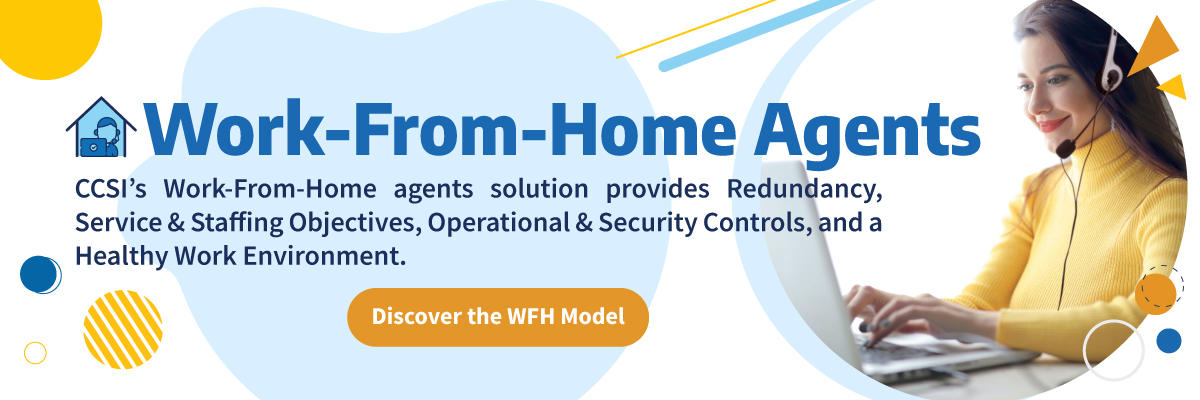
CCSI's current Work-From-Home Contact Center model incorporates operational and security controls, real-time performance monitoring, and remote workforce management to support productivity and business continuity.
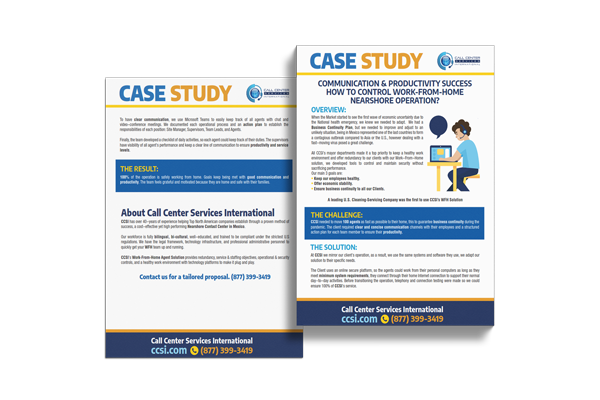
Explore how structured communication, performance monitoring, employee support, and operational controls can improve productivity and strengthen a remote contact center operation.
Call Center Services International (CCSI) helps U.S. organizations establish and manage nearshore contact center operations in Mexico, including secure and scalable Work-From-Home Contact Center teams.
CCSI combines professional bilingual and bicultural agents with recruiting, Human Resources, continuous training, Workforce Management, Quality Assurance, technology infrastructure, operational support, and a comprehensive cybersecurity and compliance framework.
CCSI's remote model provides operational and security controls, real-time monitoring, workforce flexibility, and business continuity capabilities while allowing organizations to integrate remote professionals into their existing contact center processes and performance objectives.
Historical note: First published in 2020 during a period of rapid expansion in remote contact center operations, this article has been reviewed and updated while preserving its original focus on work-from-home set-up, supervision, employee support, motivation, and team connection. References to CCSI's internal employee podcast reflect a company initiative in place at the time of the original publication, while information about current security, monitoring, and remote workforce capabilities has been updated to reflect CCSI's present Work-From-Home model.
Originally published: July 2, 2020
Last reviewed and updated: July 25, 2026



The latest industry insights & news from CCSI, Specialists in Establishing Contact Centers in Mexico for Debt Collection, Customer Service, Sales, BPO and more.