

NEWS & INSIGHTS
The latest industry insights & news from CCSI, Specialists in Establishing Contact Centers in Mexico for Debt Collection, Customer Service, Sales, BPO and more.

NEWS & INSIGHTS
The latest industry insights & news from CCSI, Specialists in Establishing Contact Centers in Mexico for Debt Collection, Customer Service, Sales, BPO and more.
Call Center Services International (CCSI) provides nearshore contact center services in Mexico, but our operating model differs from traditional outsourcing. Rather than asking clients to hand over complete control of a business function, CCSI is designed to become an extension of the existing U.S. operation while the client maintains control over its processes, people, technology, training, quality standards, and performance objectives.
When this article was originally published in 2018, we explained that CCSI did not consider its model to be traditional outsourcing.
That distinction remains important today.
CCSI certainly provides many of the advantages associated with nearshore outsourcing, including lower operating costs, access to additional talent, professional infrastructure, and administrative support in Mexico. However, the way the operation is structured gives clients a different level of involvement and control than many traditional outsourcing arrangements.
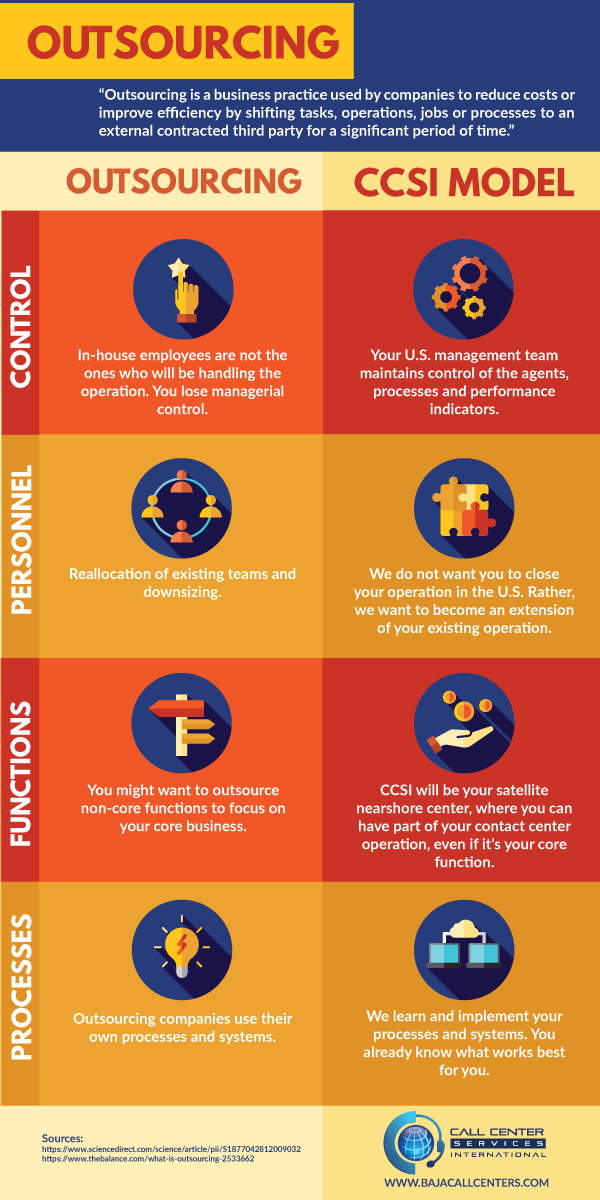
The four areas identified in the original article remain central to understanding the difference:
Outsourcing generally involves contracting an external organization to perform a business function, process, or service that might otherwise be handled internally.
There are many different outsourcing models, and outsourcing itself is not inherently good or bad. The appropriate model depends on how much responsibility an organization wants to delegate and how closely it wants to remain involved in the outsourced operation.
In some traditional BPO arrangements, the service provider determines much of the day-to-day management approach, staffing structure, technology, workflows, and operational methodology required to deliver an agreed result.
CCSI's nearshore model is designed differently.
The objective is to establish a team in Mexico that functions as an extension of the client's existing organization rather than as a separate operation with an entirely different way of working.
The first distinction identified in the original article was control.
Organizations often worry that outsourcing a customer-facing operation means losing visibility or influence over how that operation is managed.
CCSI's model is specifically designed to allow the client to remain closely involved.
Depending on the program selected, clients can maintain control over areas such as:
CCSI provides local management and operational resources in Mexico, but those teams work within the client's defined requirements and organizational objectives.
Nearshore proximity further supports this level of control.
With operations in Mexico and working hours aligned with the United States, client managers can communicate with their teams in real time, participate in meetings and training, review performance, and make operational adjustments without the challenges that can come with widely separated time zones.
For clients operating from CCSI's Tijuana facilities, geographic proximity to San Diego provides an additional advantage for site visits, training, audits, and executive meetings.
The second distinction is how the nearshore workforce relates to the client's existing employees.
The original article emphasized that CCSI was not designed simply to replace an existing U.S. operation. Instead, companies could maintain their domestic teams while adding capacity through a dedicated satellite operation in Mexico.
That remains an important use of the nearshore model.
A company may need additional employees because of growth, recruiting challenges, seasonal demand, bilingual requirements, expanded business hours, new customers, or the need to create additional operational capacity.
Rather than rebuilding the entire operation around a third-party service provider, the Mexico team can be integrated with the existing organization.
The U.S. and Mexico teams can share:
This approach helps the nearshore team function as additional workforce capacity rather than as an isolated vendor.
CCSI supports this model with bilingual and bicultural professionals in Mexico who can be recruited and trained according to each client's requirements.
The third distinction from the original article involved the type of work companies can assign to their Mexico operation.
Traditional outsourcing is often associated with moving non-core or repetitive tasks to an external provider so the internal organization can focus on its primary business activities.
That can still be a useful strategy, but it is not the only way to use a nearshore operation.
Because clients remain involved in management, processes, training, and technology, CCSI teams can support business functions that require closer integration with the existing organization.
Current CCSI operations support areas including:
The important point is that the nearshore team can be built around the requirements of the business rather than limiting the operation to a predetermined list of standardized outsourcing processes.
The fourth distinction may be one of the most important: process integration.
A traditional outsourcing provider may already have established systems, workflows, scripts, management procedures, and technology that it uses to deliver services for multiple clients.
That approach can work well when an organization specifically wants the provider to take responsibility for designing and managing the process.
But many companies already know how they want their operation to work.
They have spent years developing systems, training programs, customer-service procedures, compliance requirements, Quality Assurance standards, reporting methods, and technology that already support their business successfully.
In those situations, there may be little reason to replace everything simply because part of the workforce is now located in Mexico.
No one understands your business better than your own organization. When your existing processes work, the objective should be to extend them to the Mexico team rather than unnecessarily reinvent them.
Depending on the requirements of the operation, the Mexico team can work with the client's existing:
This allows the client to maintain consistency across locations and gives managers greater visibility into performance.
CCSI provides the local facilities and enterprise infrastructure in Mexico while the operating environment can be configured around the client's business requirements.
The fundamental model described in the original 2018 article remains part of CCSI's current service structure.
Today, organizations can select between two primary approaches depending on the level of customization, investment, and infrastructure they require.
CCSI's Turnkey Program allows companies to establish a nearshore operation within CCSI's existing corporate and operational infrastructure.
The client maintains control over processes, quality standards, training, technology, and day-to-day business operations while CCSI manages the local operating framework in Mexico.
CCSI provides resources including:
Organizations requiring a more customized environment can use CCSI's Corporate Advantage Program.
This model allows companies to establish infrastructure around specific operational, technology, equipment, staffing, and business requirements while maintaining direct control over the operation.
The result is a dedicated Mexico contact center designed around the client's organization rather than requiring the organization to adapt itself to a standardized BPO environment.
The terminology around outsourcing has evolved since this article was first published.
Nearshoring is itself a form of outsourcing in the broad business sense because an organization is using an external partner and workforce in another country to perform business functions.
The more useful distinction is therefore not simply whether something is called “outsourcing.” It is how the relationship is structured.
Companies evaluating a provider should ask:
These questions explain the distinction CCSI was trying to make when this article was first published in 2018.
CCSI provides the legal, administrative, recruiting, facilities, technology infrastructure, and local operational framework required to establish a contact center in Mexico, while clients can retain control of the business functions that define how their customers are served.
The CCSI model combines the economic and workforce advantages of nearshoring with the operational control and process consistency of an internal team.
Call Center Services International (CCSI) helps U.S. organizations establish and manage high-performance nearshore contact centers in Mexico.
CCSI provides bilingual and bicultural talent, recruiting, Human Resources, professional facilities, enterprise technology infrastructure, Quality Assurance, Workforce Management, administrative support, and local operational resources.
Rather than requiring clients to adopt a standardized operating model, CCSI can integrate its Mexico teams with existing client systems, processes, training programs, technology, performance objectives, and customer experience standards.
With strategic operations in Tijuana, Mexico City, and Guadalajara, CCSI helps companies expand their workforce while maintaining close communication, visibility, and operational control.
Explore CCSI's Turnkey Nearshore Contact Center Model
The original 2018 article referenced the following resources when discussing traditional outsourcing models:
Historical note: This article was originally published in 2018 to explain why CCSI distinguished its nearshore operating model from traditional outsourcing. The four original areas — control, personnel, functions, and processes — have been preserved. The article has been updated to clarify modern outsourcing terminology and reflect CCSI's current Turnkey and Corporate Advantage programs, expanded Mexico locations, and current operating structure.
Originally published: January 11, 2018
Last reviewed and updated: July 26, 2026



The latest industry insights & news from CCSI, Specialists in Establishing Contact Centers in Mexico for Debt Collection, Customer Service, Sales, BPO and more.