

NEWS & INSIGHTS
The latest industry insights & news from CCSI, Specialists in Establishing Contact Centers in Mexico for Debt Collection, Customer Service, Sales, BPO and more.

NEWS & INSIGHTS
The latest industry insights & news from CCSI, Specialists in Establishing Contact Centers in Mexico for Debt Collection, Customer Service, Sales, BPO and more.
A call center is a business operation responsible for managing incoming and outgoing communications between a company and its customers or potential customers. While the term traditionally refers to voice calls, modern contact center operations may also support customers through email, live chat, SMS, social media, and other digital channels.
A call center is a business department or operation responsible for handling incoming and outgoing calls between an organization and its customers, prospects, or other contacts. The employees who manage these interactions are generally known as call center agents or representatives.
Not every company operates its own call center. Organizations typically establish a dedicated contact center operation when the volume or complexity of customer interactions requires specialized employees, technology, management, training, and processes.
A call center can be managed internally as part of the company or supported by an external service provider. In either case, these teams often represent one of the most direct connections between a company and its customers.
The terms call center and contact center are often used interchangeably, but there is an important distinction between them.
Traditionally, a call center focuses primarily on voice communications, including incoming and outgoing telephone calls.
A contact center can manage communications across multiple channels, such as:
As customer communication has expanded beyond the telephone, many organizations now operate omnichannel contact centers. However, the term call center is still commonly used to describe these operations.
No. A call center or contact center describes an operating environment, while customer service and customer support describe types of work that may be performed within that environment.
The terms are often confused because customer service operations represent a significant portion of contact center activity.
Customer service generally refers to the assistance a company provides before, during, and after a customer purchases a product or service. This can include answering questions, helping with orders, providing information, receiving feedback, resolving basic issues, and improving the overall customer experience.
Customer support generally focuses more specifically on helping customers resolve problems or questions involving a product, service, account, or technical issue. Depending on the company and industry, customer service and customer support responsibilities may overlap.
Call centers are an important part of customer service and customer support, but they can perform many other business processes as well. Contact center teams may support sales, lead generation, surveys, debt collection, loan servicing, technical support, back-office processes, Quality Assurance, and other customer-facing or operational functions.
Call center operations are also commonly classified as inbound or outbound depending on who initiates the interaction.
Inbound interactions are initiated by customers, prospects, or other external contacts. Common inbound processes include:
In a modern contact center, inbound communication can also include live chat, email, messaging, and other digital channels.
Outbound interactions are initiated by the company or its representatives. Common outbound processes include:
Smaller operations may have the same agents handling both inbound and outbound activities, while larger contact centers often organize specialized teams according to the type of interaction, required skills, technology, and performance objectives.
Call center outsourcing occurs when a company uses a third-party provider to perform some or all of its contact center functions instead of managing the entire operation internally.
Companies may consider outsourcing for different reasons, including the need to increase workforce capacity, access specialized expertise, expand hours of operation, improve scalability, enter additional labor markets, or control operating costs.
An in-house contact center is operated directly by the company using its own employees, management, infrastructure, systems, and processes.
In an outsourced model, some or all of those functions are supported by an external provider. Different providers offer different levels of operational control, staffing, technology, facilities, management, and integration with the client's existing team.
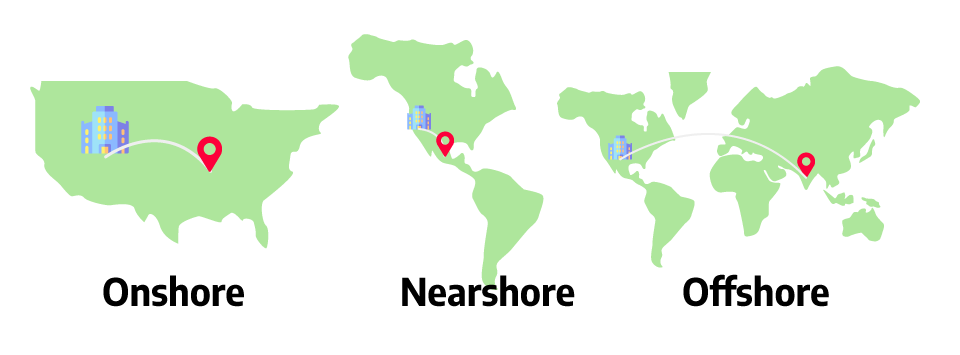
The geographic location of an outsourced operation is commonly described using three terms: Onshore, Nearshore, and Offshore.
Onshore outsourcing means working with a service provider located within the same country as the company outsourcing the operation.
This model can simplify travel, management access, language alignment, and familiarity with the domestic business environment, although operating costs may be similar to maintaining an internal operation.
Offshore outsourcing involves moving a business process to a provider located in a distant country or region.
Offshore destinations can provide access to large workforce markets and competitive operating costs. Organizations evaluating an offshore model should also consider language capabilities, cultural alignment, time zones, travel requirements, infrastructure, security, and management accessibility.
Nearshore outsourcing involves establishing or outsourcing an operation in a nearby country. For U.S. organizations, Nearshore Mexico can provide many of the workforce and cost advantages associated with international operations while maintaining geographic proximity, cultural alignment, and compatible time zones.
Mexico also provides access to a large bilingual and bicultural contact center workforce, making it an important nearshore option for organizations serving English- and Spanish-speaking customers in North America.
Choosing between an in-house, onshore, nearshore, or offshore contact center should depend on the specific needs of the operation. Organizations should consider workforce availability, language requirements, customer experience, security, compliance, infrastructure, management control, scalability, operating costs, and the type of customer interactions being handled.
Call Center Services International (CCSI) helps U.S. organizations establish and manage nearshore contact center operations in Mexico. CCSI supports inbound and outbound operations across areas such as customer service, debt collection, loan servicing, Quality Assurance, technical support, sales, and other business processes.
CCSI combines professional bilingual and bicultural agents with recruiting, Human Resources, continuous training, Workforce Management, professional contact center facilities, technology infrastructure, and operational support.
With operations in Tijuana, Mexico City, and Guadalajara, CCSI provides U.S. companies with access to multiple workforce markets while maintaining the proximity and cultural alignment of a Nearshore Mexico strategy.
Historical note: First published in 2021, this article has been reviewed and updated while preserving its original purpose as an introduction to common call center industry terminology. Definitions and examples have been expanded to reflect the evolution from traditional voice-based call centers toward modern omnichannel contact centers, while the original concepts of inbound, outbound, in-house, onshore, nearshore, and offshore operations remain central to the article.
Originally published: May 3, 2021
Last reviewed and updated: July 25, 2026



The latest industry insights & news from CCSI, Specialists in Establishing Contact Centers in Mexico for Debt Collection, Customer Service, Sales, BPO and more.