

NEWS & INSIGHTS
The latest industry insights & news from CCSI, Specialists in Establishing Contact Centers in Mexico for Debt Collection, Customer Service, Sales, BPO and more.

NEWS & INSIGHTS
The latest industry insights & news from CCSI, Specialists in Establishing Contact Centers in Mexico for Debt Collection, Customer Service, Sales, BPO and more.
Contact Centers are known for experiencing employee turnover, but the true cost of attrition can be much greater than the salary or recruiting expense associated with replacing an agent. When an experienced employee leaves, organizations may incur costs related to offboarding, recruiting, hiring, training, reduced productivity, management time, and the period required for a new employee to become fully proficient.
Understanding the real cost of Contact Center turnover can help organizations determine where retention efforts may provide the greatest operational and financial value.
The cost begins when an employee leaves and continues through recruiting, onboarding, training, and the time required for a replacement agent to reach the expected level of performance.
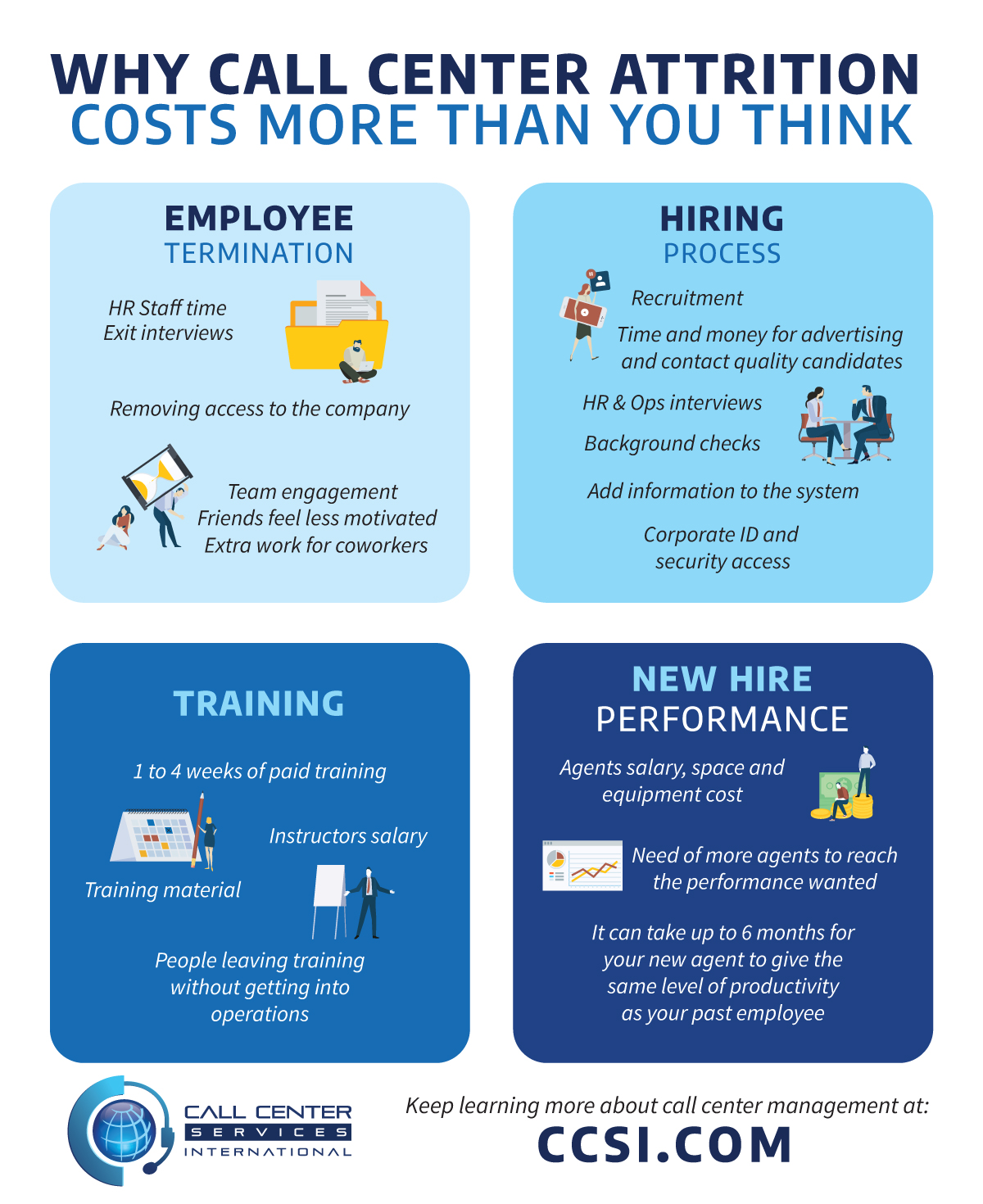
The exact cost will vary significantly depending on the position, training requirements, compensation, recruiting model, complexity of the operation, and time required for the new employee to become proficient. However, the following four categories provide a useful framework for evaluating the broader impact of attrition.
When an employee leaves the organization, whether voluntarily or involuntarily, Human Resources, Payroll, Operations, IT, Security, and Management may all spend time completing the offboarding process.
Depending on the organization, these activities may include:
An employee's departure can also have an operational impact on the remaining team. Other agents may temporarily need to absorb additional workload, schedules may need to be adjusted, and Supervisors may spend additional time maintaining service levels while the position remains open.
When turnover becomes frequent, these individual events can accumulate into a significant operational burden.
Replacing an agent requires recruiting resources as well as time from multiple departments.
The hiring process may involve:
In addition to direct recruiting expenses, consider the time invested by Recruiters, Human Resources personnel, Hiring Managers, Supervisors, IT personnel, and other employees participating in the process.
High attrition can create a cycle in which recruiting teams spend substantial time continuously replacing employees instead of supporting planned growth.
Once a new employee is hired, the organization begins investing in training before that person can independently perform the role.
Depending on the operation, training expenses may include:
Training duration varies significantly according to the complexity of the operation. Some programs may require relatively short onboarding periods, while technical, financial, healthcare, collections, or other specialized operations may require more extensive preparation.
Organizations should also consider training attrition. When an employee leaves before completing training or shortly after joining the production floor, much of the recruiting and training investment must be repeated for another candidate.
Completing training does not necessarily mean a new agent immediately performs at the same level as an experienced employee.
During the initial weeks or months on the production floor, new agents may need additional time to navigate systems, understand processes, resolve unfamiliar customer situations, achieve Quality Assurance expectations, and reach normal productivity levels.
Supervisors, Trainers, Quality Assurance teams, and experienced agents may also spend additional time coaching and supporting new employees during this ramp-up period.
The time required to reach full proficiency depends on the complexity of the program, the employee's previous experience, training quality, systems, management support, and performance expectations.
This productivity gap is one of the reasons the financial impact of turnover can extend well beyond the recruiting cost of replacing the employee.
Once you understand the different costs associated with turnover, the next step is determining why employees are leaving.
Attrition can have many causes, including recruiting mismatches, ineffective onboarding, insufficient training, poor management, limited career opportunities, inadequate recognition, workplace conditions, compensation, workload, or other factors specific to the organization.
There is rarely one retention strategy that solves every problem. Organizations should review their own employee data, exit interviews, engagement feedback, performance information, and workforce trends to understand where improvements are needed.
Some approaches may include improving candidate selection, strengthening onboarding and training, recognizing performance, providing opportunities for professional development, supporting effective leadership, and creating a stronger employee experience.
For additional strategies, review CCSI's Best Practices to Reduce Your Call Center Attrition.
Reducing unnecessary turnover is not only an Human Resources objective. Experienced employees retain knowledge about customers, systems, processes, and the client's business, while stable teams reduce the need to repeatedly recruit, onboard, train, and develop replacements.
This makes employee experience and retention part of the broader operational strategy of a Contact Center.
Organizations should therefore evaluate attrition not only as a percentage on a workforce report, but also in terms of recruiting costs, training investment, lost productivity, management time, operational disruption, and knowledge continuity.
Call Center Services International (CCSI) helps U.S. organizations establish and manage Nearshore Contact Center operations in Mexico. CCSI provides professional bilingual and bicultural agents supported by recruiting, training, Workforce Management, technology infrastructure, and operational support.
CCSI's people-first company culture focuses on work environment and motivation, employee recognition, professional development, internal growth, and continuous learning—practices designed to create stable and experienced Contact Center teams.
By investing in employee experience and development, CCSI helps clients build teams with greater continuity while reducing the recruiting, onboarding, and training disruption associated with unnecessary turnover.
Historical note: First published in January 2023, this article has been reviewed and updated while preserving its original four-part framework for understanding the cost of Contact Center attrition: employee departure, hiring, training, and new hire performance. Specific timelines originally presented for training and productivity ramp-up have been generalized because these periods vary significantly according to the complexity of each operation, employee experience, training requirements, and performance expectations.
Originally published: January 11, 2023
Last reviewed and updated: July 25, 2026



The latest industry insights & news from CCSI, Specialists in Establishing Contact Centers in Mexico for Debt Collection, Customer Service, Sales, BPO and more.